

By Sanjay Dubey
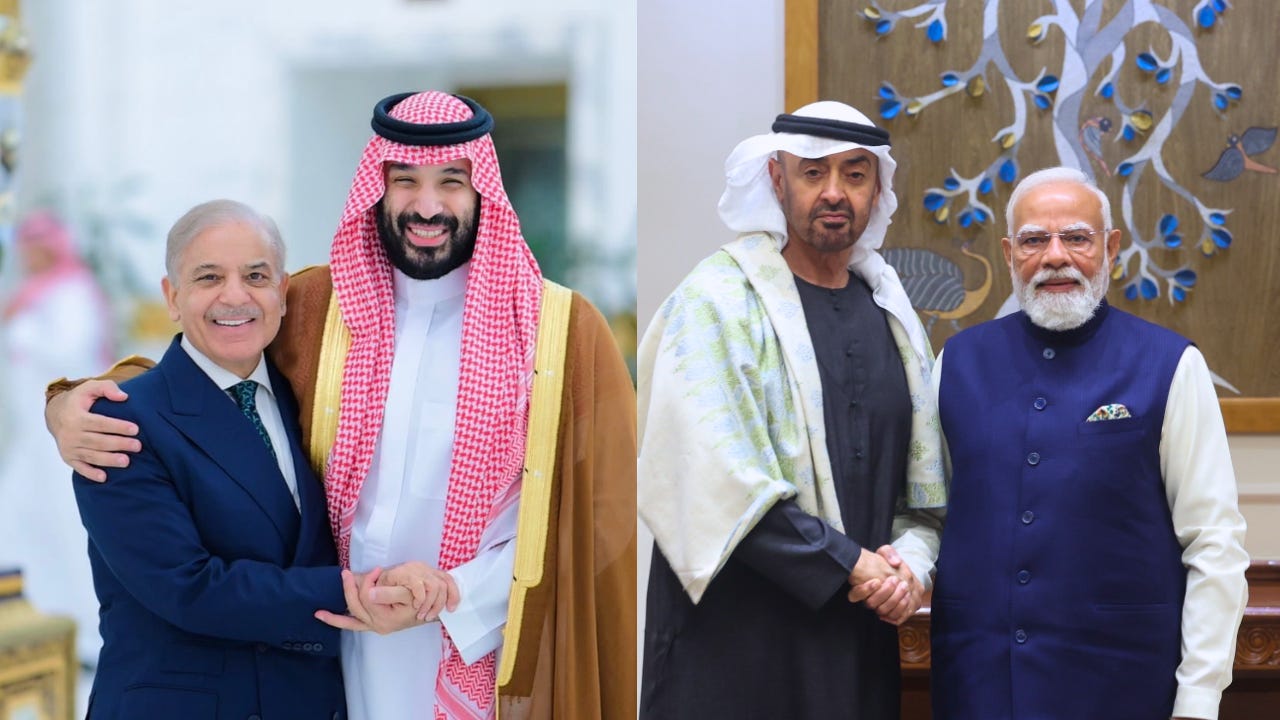
For decades, the friction between India and Pakistan was largely contained within South Asia. Occasionally, it spilled into international forums, and at times its echoes reached the Middle East—though usually confined to cricket fields. That is now changing. In recent months, the Middle East has emerged as a primary arena for this rivalry. At the center of this shift is an informal alignment of four Islamic nations, with Pakistan playing a leading role.
This development stands in contrast to the formal Quad that India had invested significant strategic capital in. The Quadrilateral Security Dialogue—consisting of the United States, Japan, Australia, and India—was born from shared relief efforts after the 2004 Indian Ocean tsunami and eventually formalised to ensure a free and open Indo-Pacific. For New Delhi, it was a golden ticket to a high table where it could balance the rising influence of China. However, Donald Trump’s return to the White House and his administration’s isolationist “America First” stance, along with cooler India–US relations, have left it a largely dormant forum.
Even as the original Quad faded into the background, a new and more assertive formation began to take shape in West Asia. This informal Quad—bringing together Pakistan, Egypt, Turkey, and Saudi Arabia (PETSA)—has evolved from a collection of shared interests into a more coordinated alignment, sometimes described as a “West Asian Quad,” or “Islamic NATO.” Unlike the formal Quad, which has often moved cautiously, PETSA seems to be moving faster on key security and strategic issues. For New Delhi, the irony is hard to miss: this emerging alignment, which places Pakistan at its centre, appears to draw tacit support from the United States, the leader of the original Quad, and China, the very power the Quad was designed to counter.
To understand this shift better, it helps to recall the optimism of the early 2020s. At the time, India was central to a new diplomatic architecture. The Quad was at its peak, holding high-profile summits and moving with a sense of purpose aimed at balancing China’s growing influence. It was in this atmosphere that the I2U2 (India, Israel, the UAE, and the US) also took shape. Often described as a “West Asian Quad,” it complemented the original Quad’s broader strategic outlook. Together, these frameworks reflected India’s attempt to project influence across both the Indo-Pacific and West Asia. But as the political climate in Washington shifted, the momentum behind this approach began to decline.
Subscribe to get updates, bookmark, or comment.